Retail and local businesses · DP059
WhatsApp customer lists need more care than a broadcast button
Treat customer messaging lists as purpose-bound data flows, with clear ownership, withdrawal handling and controlled copies.
Research cutoff: . This dated explainer is general information; check the linked instruments and your circumstances before acting.

A shop’s customer list often grows one useful interaction at a time. A customer asks about stock, another shares a delivery location, and a third requests a receipt. Months later, the saved numbers look like a ready-made audience for promotions. The original reasons for collecting them have disappeared from view.
Before sending another campaign, recover that context. A messaging tool makes delivery convenient; it does not decide whether your business has an appropriate basis for every message or every use of the contact list.
Separate the message types
Create a practical distinction between service messages and promotions. A reply about a customer’s current order has a different purpose from an offer for an unrelated product. Calling a promotion an update does not change what it asks the customer to receive.
As of 22 October 2026, the substantive DPDP framework discussed here is scheduled for 13 May 2027 under the commencement notification. The future sections 4 to 7 will require an appropriate processing route for a lawful purpose. Section 7(a)’s specified-purpose voluntary-provision route should not be expanded into permission to send any later message merely because someone once contacted the business.
Where you rely on consent, prepare an explanation and evidence that fit the promotional purpose. Assess other applicable messaging requirements and the service’s current terms separately. This article does not treat a DPDP assessment as a complete answer to those distinct requirements.
Give the list an owner
Decide who can add a number, alter a preference, export a list and initiate a campaign. A business-owned process is easier to manage than several unrelated lists on staff members’ personal devices. If personal devices are involved, document the boundaries and how business data will be handled when the person leaves.
Review the exact messaging configuration before assuming how recipients’ information is exposed. A group, a broadcast function and an integrated business service can behave differently. Test the proposed setup with synthetic contacts and inspect what participants and staff can see. Do not rely on an old screenshot or a memory of how another account worked.
The future rule 6 security framework will include access controls and related safeguards. A practical preparation step is to keep the list available only to people who need it, protect accounts and avoid uncontrolled copies. These measures must follow the actual tool configuration.
A hypothetical appliance-shop campaign
An appliance shop wants to promote a maintenance service. Its contact file mixes installation customers, people who asked one price question and people who explicitly requested future offers. The owner does not treat all three groups as equivalent.
The team first identifies the records with a supported promotional purpose. It checks that the relevant choice is linked to the correct number and that prior refusals have been carried forward. Uncertain entries are set aside for assessment rather than silently treated as permission. A staff member reviews the message to ensure it matches the purpose used to select the audience.
Before sending, the owner asks a colleague to test the stop route. The colleague’s synthetic record is removed from the next eligible audience, including a copy held by the outside campaign operator. The test reveals that an old spreadsheet would otherwise have reintroduced the number.
Make a refusal affect every sender
Under the coming section 6(4) to 6(6) framework, consent withdrawal must be available with comparable ease and the affected consent-based processing must stop within a reasonable time, subject to the stated legal qualification. A message saying ‘stop’ needs a defined operational route even if the sender is not the person maintaining the list.
Record the affected purpose and update queued campaigns, exports and other sending accounts. Keep any minimal suppression evidence appropriately restricted so an old import does not undo the choice. Do not use a refusal as an excuse to delete records blindly without assessing applicable retention requirements.
Watch the attachments as well as the numbers
Customer conversations may contain addresses, receipts, photographs or service notes. Forwarding the entire chat to a technician can disclose much more than the technician needs. Share the relevant instruction through an approved route and keep unrelated history out of the handoff.
The recurring failure is treating the sending button as the beginning of the process. The meaningful decisions happen earlier: why the detail was collected, who can use it and how the person’s choice changes the audience. Review those decisions before the next message leaves the business.
Follow a message list from source to stop
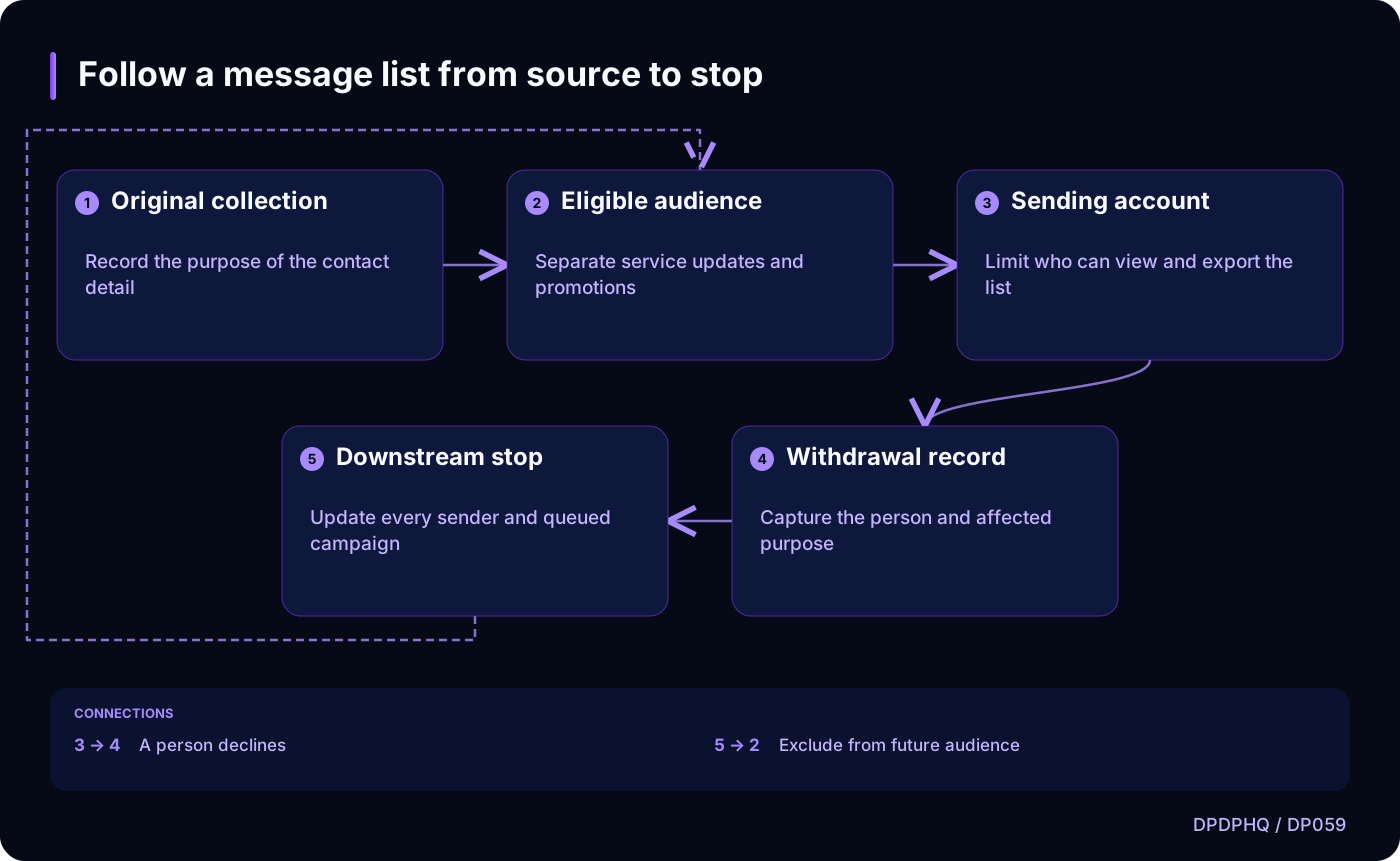
Text version of the diagram
- Original collection: Record the purpose of the contact detail
- Eligible audience: Separate service updates and promotions
- Sending account: Limit who can view and export the list
- Withdrawal record: Capture the person and affected purpose
- Downstream stop: Update every sender and queued campaign
- Original collection → Eligible audience
- Eligible audience → Sending account
- Sending account → Withdrawal record: A person declines
- Withdrawal record → Downstream stop
- Downstream stop → Eligible audience: Exclude from future audience
Sources and reading context
These references support the original 22 October 2026 research. Source links and the date above make the scope of this article explicit.
- Commencement notification for provisions of the DPDP Act · paragraph (c)
Dates the substantive provisions
- Digital Personal Data Protection Act, 2023 · sections 4 to 7, 6(4) to 6(6), 8(1)
Supports purpose, withdrawal and accountability
- Digital Personal Data Protection Rules, 2025 · rule 6
Supports access and security controls