Operations and measurement · DP094
A quarterly privacy review that ends with decisions
Use a periodic privacy review to resolve a small set of consequential questions and assign concrete actions.
Research cutoff: . This dated explainer is general information; check the linked instruments and your circumstances before acting.

A privacy review can become a meeting in which everyone reports that work is ongoing. The policies are listed, a dashboard is shown and the same unresolved questions return next quarter. The missing ingredient is a decision that somebody can act on.
Design the meeting around a small set of choices. Bring the evidence needed to make them, and leave with an owner, an action and a way to recognise a sufficient result.
Treat the cadence as a practical choice
A quarterly review can be useful for a small team, but the sources cited here do not prescribe one universal quarterly meeting for every business. As of 22 October 2026, the relevant substantive DPDP duties are scheduled for 13 May 2027 under the commencement notification.
The future section 8 framework and rule 6 make ongoing control and accountability important. The separate SDF provisions in section 10 and rule 13 have their own periodic assessment requirements. Do not confuse your chosen operating rhythm with that specific statutory regime or with requirements under other applicable law.
Choose a cadence that fits change and risk. A significant new data flow should be reviewed when proposed, not held until a calendar meeting arrives.
Ask for three inputs before the meeting
First, collect changes: new tools, fields, providers, recipients, purposes and staff access arrangements. Ask what changed in the actual data path, not only which policy was edited.
Second, bring a small evidence sample. It might show a withdrawal test, a provider exit, an access removal or a correction reaching the relevant systems. Choose a meaningful case and state what the sample does not establish.
Third, identify unresolved decisions. For each, present the question, the evidence, the available options and the consequence of waiting. A request for a decision is more useful than a long status paragraph that nobody can respond to.
A hypothetical review agenda
A small services company has added a booking provider, completed an access review and left a retention question unresolved. The meeting does not begin by rereading every policy. It considers whether the new provider receives an unnecessary note field, whether the removed accounts are actually inaccessible and what evidence is needed to settle the retention issue.
The first decision narrows the provider payload. The second accepts the verified account-removal result for its tested scope and assigns a separate check of shared links. The third commissions a focused legal assessment with a named internal owner and an interim access restriction.
The minutes record those decisions and their limits. They do not declare the organisation fully compliant because the meeting took place or because several items were discussed.
Keep the discussion attached to evidence
If a control is described as working, ask what was observed and when. If the evidence is a screenshot, identify the system and configuration it represents. If a provider supplied an assurance, ask which service and period it covers.
Avoid turning the review into a search for raw personal data. Use synthetic examples or appropriately limited evidence where possible. Keep detailed incident or identity material in its restricted location and bring only the information needed for the decision.
Where evidence is missing, record the gap openly. A confident verbal assurance should not silently become a completed control entry.
Make actions concrete enough to close
‘Improve training’ is not a complete action. ‘Update the counter script, demonstrate the decline path to staff and test the next campaign export with a synthetic record’ identifies work and evidence.
Name one accountable owner even when several people contribute. Record dependencies and a target date. If the action requires a business trade-off, identify who can make it rather than leaving the implementer to guess.
Separate urgent incident handling from the routine meeting. A concern that requires immediate assessment should follow the appropriate escalation process instead of waiting for quarterly approval.
Begin the next review with the previous decisions
Check whether the actions changed the intended behaviour. Close them only for the scope supported by evidence. If a change introduced a new problem or the test failed, revise the action without disguising it as completed progress.
Then ask whether the inventory, notice, contract or operating instruction needs to reflect the change. A successful technical fix can still leave staff following an obsolete process.
Repeated status reports are not enough to resolve the decisions on the agenda. A useful review ends with a short set of decisions and makes the next review capable of testing whether those decisions were carried out.
Turn the review meeting into a decision loop
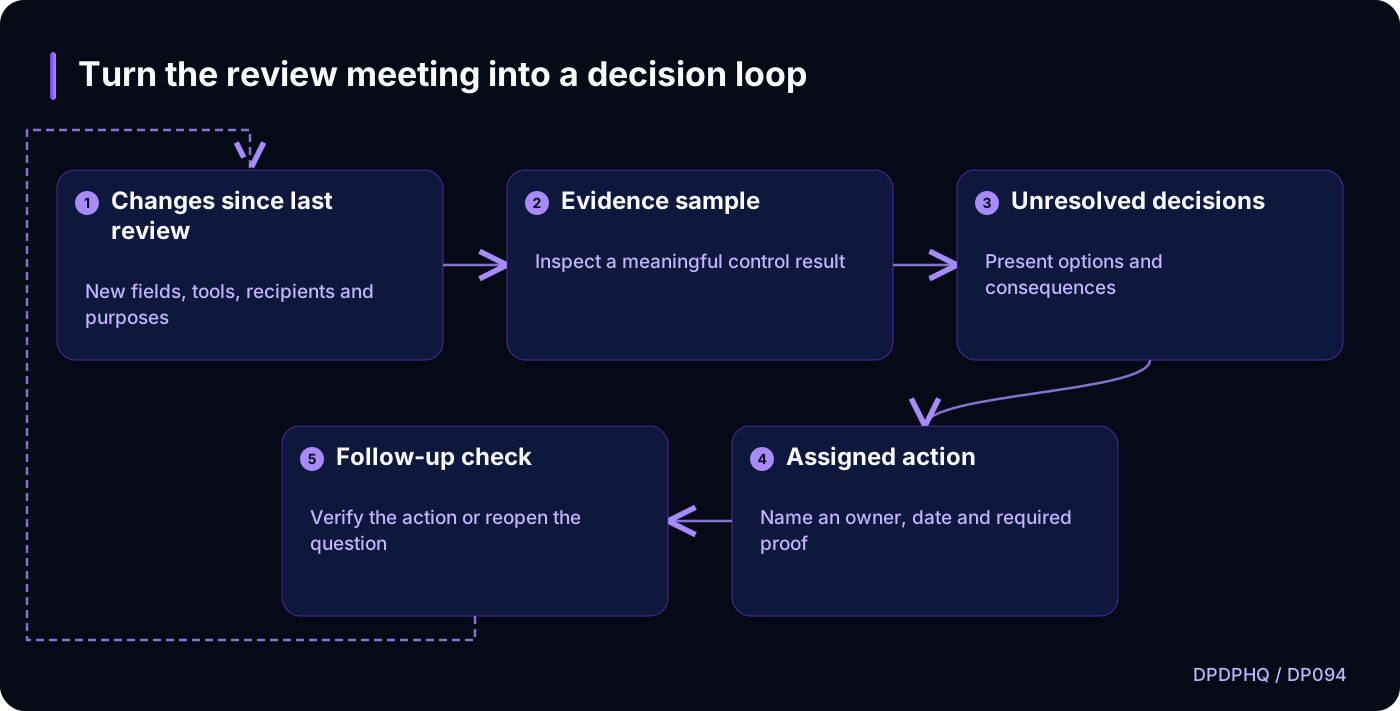
Text version of the diagram
- Changes since last review: New fields, tools, recipients and purposes
- Evidence sample: Inspect a meaningful control result
- Unresolved decisions: Present options and consequences
- Assigned action: Name an owner, date and required proof
- Follow-up check: Verify the action or reopen the question
- Changes since last review → Evidence sample
- Evidence sample → Unresolved decisions
- Unresolved decisions → Assigned action
- Assigned action → Follow-up check
- Follow-up check → Changes since last review
Sources and reading context
These references support the original 22 October 2026 research. Source links and the date above make the scope of this article explicit.
- Commencement notification for provisions of the DPDP Act · paragraph (c)
Dates future duties
- Digital Personal Data Protection Act, 2023 · sections 8 and 10
Ordinary responsibilities and SDF distinctions
- Digital Personal Data Protection Rules, 2025 · rules 6 and 13
Safeguards and SDF-specific periodic assessment